
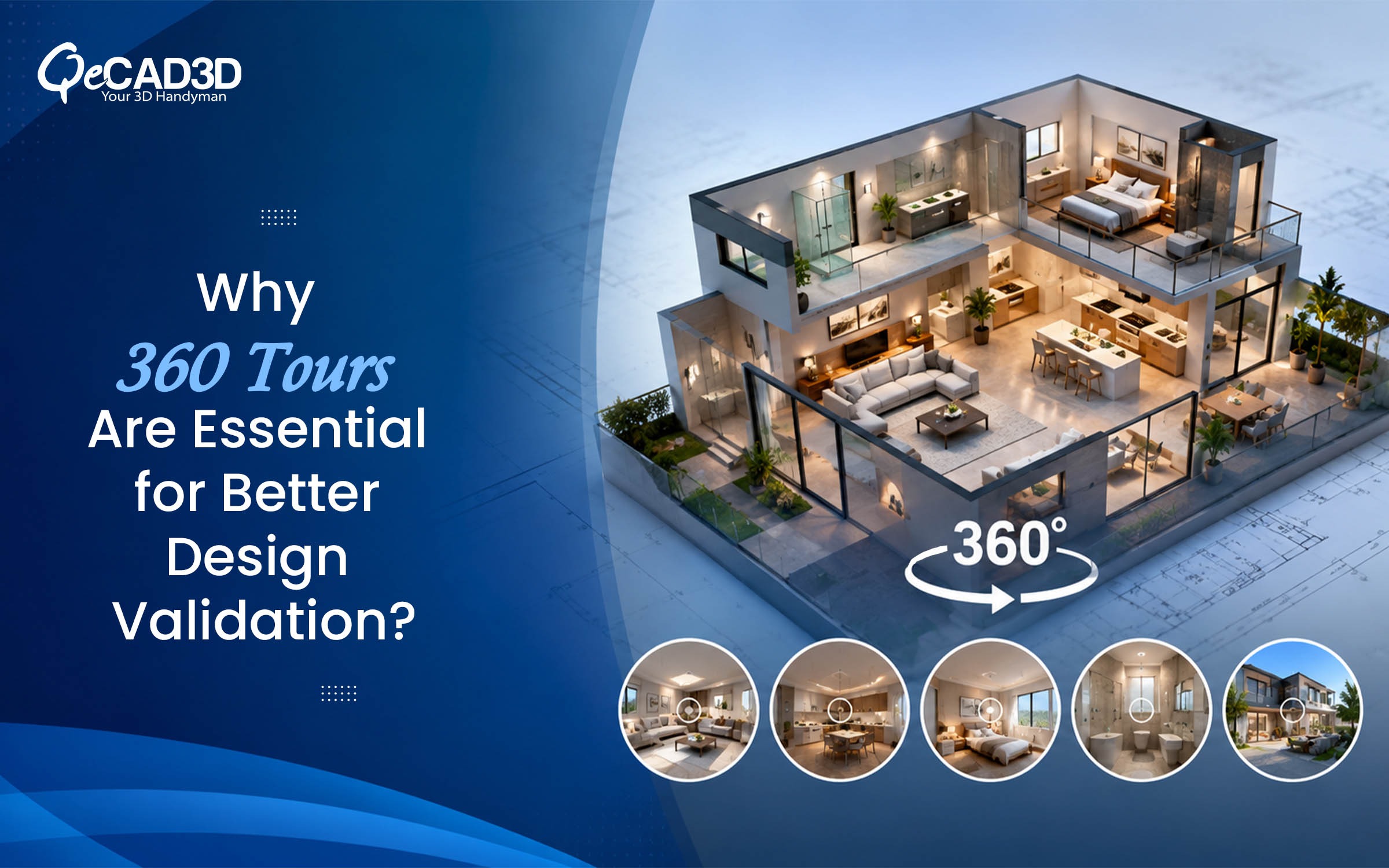
Why 360 Tours Are Essential for Better Design Validation?
Introduction
Design changes during the construction frequently contribute to project delays, increased construction costs and stakeholder frustration. While modifications are often necessary to address the unforeseen issues, many change requests stem from one simple problem: stakeholders struggle to fully understand the design before the construction begins.
Traditional drawings, plans and even static visualizations can leave room for interpretation, making it difficult for clients, architects, contractors and project teams to align expectations. This is where 360-degree virtual tours are transforming the design review process.
By allowing stakeholders to experience a project before it is built, 360 tours provide a realistic and immersive understanding of spaces, helping teams to identify concerns early and make informed decisions. As a result, projects can significantly reduce costly design revisions at the time of actual construction.
The Challenge of Late Design Changes
Construction projects require collaboration among numerous stakeholders, all of whom may have distinct goals and priorities. Even when the detailed drawings and models are available, many design concerns remains unnoticed until the construction is underway.
Common issues that leads to design changes includes:
- Misinterpretation of layouts and room dimensions
- Poor visualization of spatial relationships
- Unclear material and finish selections
- Accessibility and circulation concerns
- Stakeholder feedback received too late in the process
Once construction starts, addressing these issues often requires reworks, additional labor, schedule adjustments and increased project costs.
What Are 360 Virtual Tours?
A 360 virtual tour enables stakeholders to navigate and experience a proposed space interactively before construction begins. Unlike static renderings, users can smoothly go through rooms, inspect details and gain a realistic sense of scale and layout.
These tours create an immersive environment where the decision-makers can virtually walk through a project long before the construction begins.
How 360 Tours Help Reduce Design Changes?
- Improved Design Understanding
One of the biggest advantages of 360 tours is their ability to communicate the design intent clearly.
Clients as well as non-tech stakeholders usually find it challenging to interpret the floor plans or technical drawings. A virtual walkthrough removes this barrier by presenting the design in a way that feels intuitive and realistic.
When stakeholders can see exactly how a space will look and function, they are more likely to identify the concerns during the design phase rather than just after the construction has started.
- Faster Stakeholder Approvals
Project approvals can be delayed when the stakeholders need multiple review cycles to fully understand the design.
360 tours provide a comprehensive view of the project, enabling decision-makers to review the spaces with confidence. This clarity reduces uncertainty, accelerates approvals and minimizes the likelihood of revisions at the later project phases.
- Early Identification of Functional Issues
Designs may look perfect on paper while still presenting the practical challenges in real-world use.
Virtual walkthroughs help stakeholders to evaluate:
- Space utilization
- Furniture placement
- Workflow efficiency
- User circulation
- Accessibility considerations
By identifying these issues before the construction begins, project teams can make adjustments when changes are relatively inexpensive and easy to implement.
- Better Coordination Among Project Teams
Architects, engineers, contractors, consultants and clients all contribute to the project success. Misalignment between these groups can result in design conflicts and unexpected modifications during the construction.
360 tours provides a shared visual reference that improves communication and collaboration. Everyone can review the same virtual environment thus making it easier to discuss the concerns and reach consensus before the work begins on-site.
- Enhanced Material and Finish Validation
Material selections often appear different in reality than they do in sample boards or specification documents.
Through realistic visualizations, stakeholders can assess colors, textures, finishes, lighting effects and overall aesthetics within the context of the complete design. This helps to prevent the late-stage changes driven by dissatisfaction with the final appearance.
- Reduced Risk of Costly Rework
Every design change during the construction carries financial consequences.
When project teams identifies and resolves issues during the planning phase, they avoid:
- Demolition and reconstruction
- Material waste
- Labor inefficiencies
- Schedule disruptions
- Additional consultant fees
The result is a more predictable project with fewer surprises and better cost control.
The Role of Advanced Visualization Technology
Modern Virtual Tour Services combines advanced visualization technologies with interactive navigation tools to create highly realistic project experiences. These solutions allows the stakeholders to evaluate the designs from every angle and gain confidence in project decisions before the construction starts.
When developed by an experienced 3D Rendering Company, these tours accurately represents the architectural intent, materials, lighting conditions and spatial relationships, providing a reliable basis for design reviews and approvals.
Industries Benefiting from 360 Tours
The value of 360 tours extends across multiple sectors, including:
Residential Projects
Homeowners can review layouts, finishes and room configurations before the construction begins.
Commercial Buildings
Businesses can assess the workspace functionality, branding elements and customer experiences.
Healthcare Facilities
Healthcare professionals can assess patient flow, equipment positioning, and overall operational efficiency before construction begins.
Hospitality Projects
Hotel owners and operators can review the guest experiences and interior design concepts.
Educational Institutions
Administrators can validate the classroom layouts, circulation paths and facility usability.
Best Practices for Using 360 Tours During Design Reviews
To maximize the benefits of 360 tours, project teams should:
- Conduct reviews early in the design process
- Involve all key stakeholders
- Encourage detailed feedback sessions
- Review multiple design options when necessary
- Use tours alongside BIM and construction documentation
- Document and resolve the concerns before final approvals
These practices helps in ensuring that the issues are identified and addressed before even the construction activities begin.
360 Tours: The Smart Way to Validate Designs Before Construction
Design changes during the construction can significantly impact the project budgets, schedules and overall success. While some modifications are unavoidable, many can be prevented through better visualization and communication during the planning phase.
360 virtual tours provides the stakeholders with an immersive understanding of a project before the construction starts, helping teams to identify issues, validate design decisions and achieve faster approvals. By reducing the uncertainty and improving the collaboration, these tours enables more informed decision-making and significantly decreases the likelihood of costly design changes later in the project lifecycle.
As construction projects continue to embrace the digital transformation, 360 tours are becoming an essential tool for delivering more efficient, predictable and successful project outcomes.