
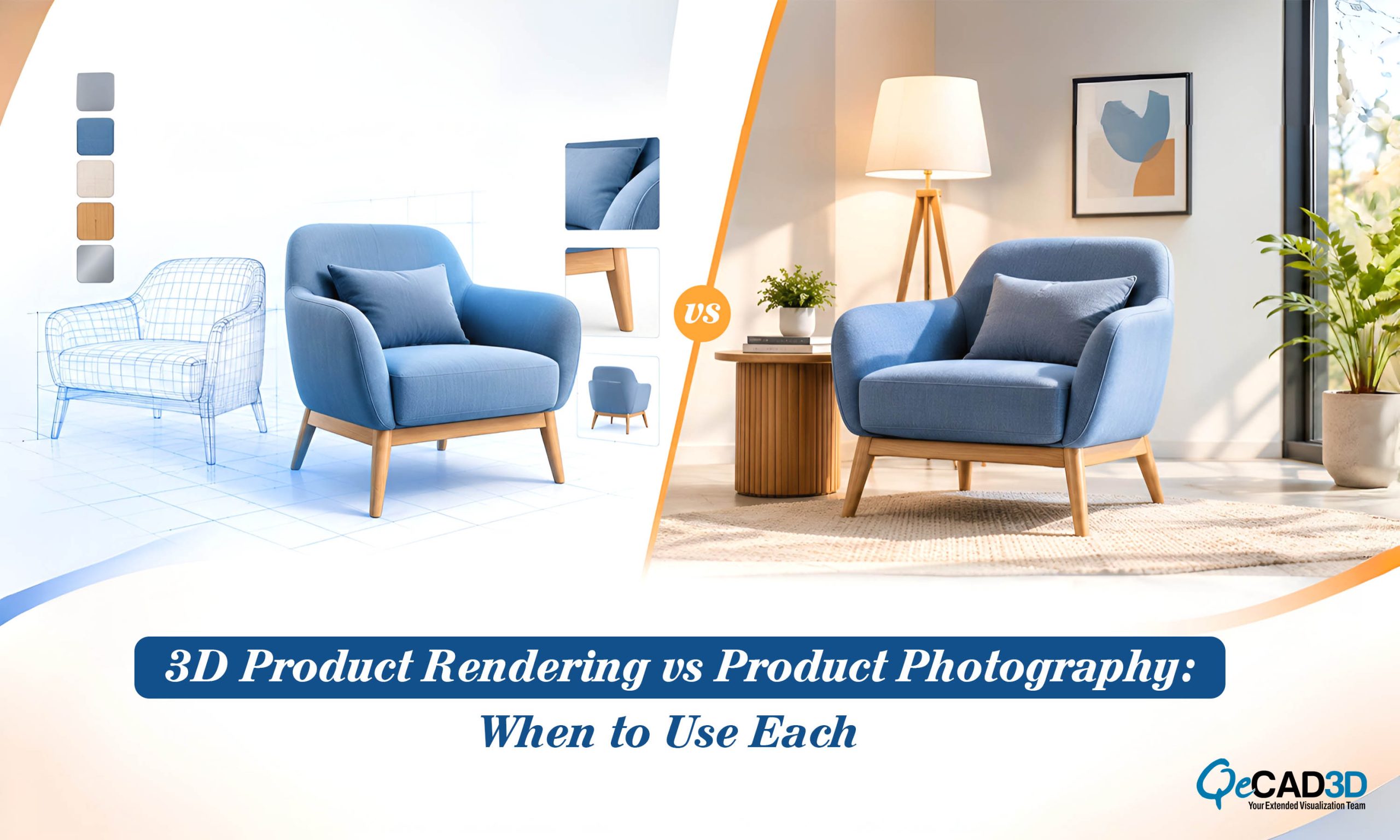
3D Product Rendering vs Product Photography: When to Use Each
Product visuals do more than make an item look attractive. They communicate form, materials, proportions, functionality, and brand quality—often before a customer ever interacts with the physical product.
Traditionally, product photography has been the standard way to create these visuals. But advances in 3D modeling and rendering have introduced another workflow: building a digital product and generating photorealistic images from it.
The question, therefore, is not simply whether 3D rendering is replacing photography. It is when does each method make technical and commercial sense?
The answer depends on the product’s development stage, number of variants, required visual outputs, level of control, and how frequently the assets will need to be updated.
What Is 3D Product Rendering?
3D product rendering is the process of creating a digital representation of a product and translating that model into a photorealistic image using virtual materials, lighting, cameras, and environments.
The workflow generally includes:
3D modeling → UV mapping → material creation → lighting → camera setup → rendering → post-production
The model may be developed from CAD files, engineering drawings, dimensions, photographs, or other technical references. Once the digital model is established, multiple views, finishes, configurations, and environments can be generated without physically photographing every variation.
This makes rendering particularly useful for products that are still under development or have numerous configurations. Shopify also identifies product rendering as useful for prototyping, ecommerce, marketing, multiple viewing angles, and product variations.
What Is Product Photography?
Product photography captures the physical product using a camera, controlled lighting, lenses, backgrounds, and often styling or props.
The workflow typically involves:
Physical product → studio/lifestyle setup → lighting → photography → retouching → final image
Its greatest advantage is that the camera captures the actual physical object—including real surface behaviour, material imperfections, reflections, textures, and interaction with a real environment.
That makes photography particularly valuable when authenticity is central to the customer’s decision.
For example, food, cosmetics, fashion, handmade products, jewelry, and lifestyle products can benefit from showing their physical characteristics rather than a digitally reconstructed representation.
Product Photography vs 3D Rendering: The Technical Difference
At a fundamental level, the two workflows begin with different sources of truth.
Photography starts with the physical product.
3D rendering starts with digital product data.
This distinction affects almost every subsequent stage.
| Factor | 3D Product Rendering | Product Photography |
| Physical sample | Not always required | Required |
| Pre-launch visuals | Highly suitable | Not possible until product exists |
| Product variants | Easy to reproduce digitally | Usually requires additional shooting |
| Camera angles | Fully controllable | Limited to captured views |
| Materials/colors | Can be digitally changed | Requires physical variant |
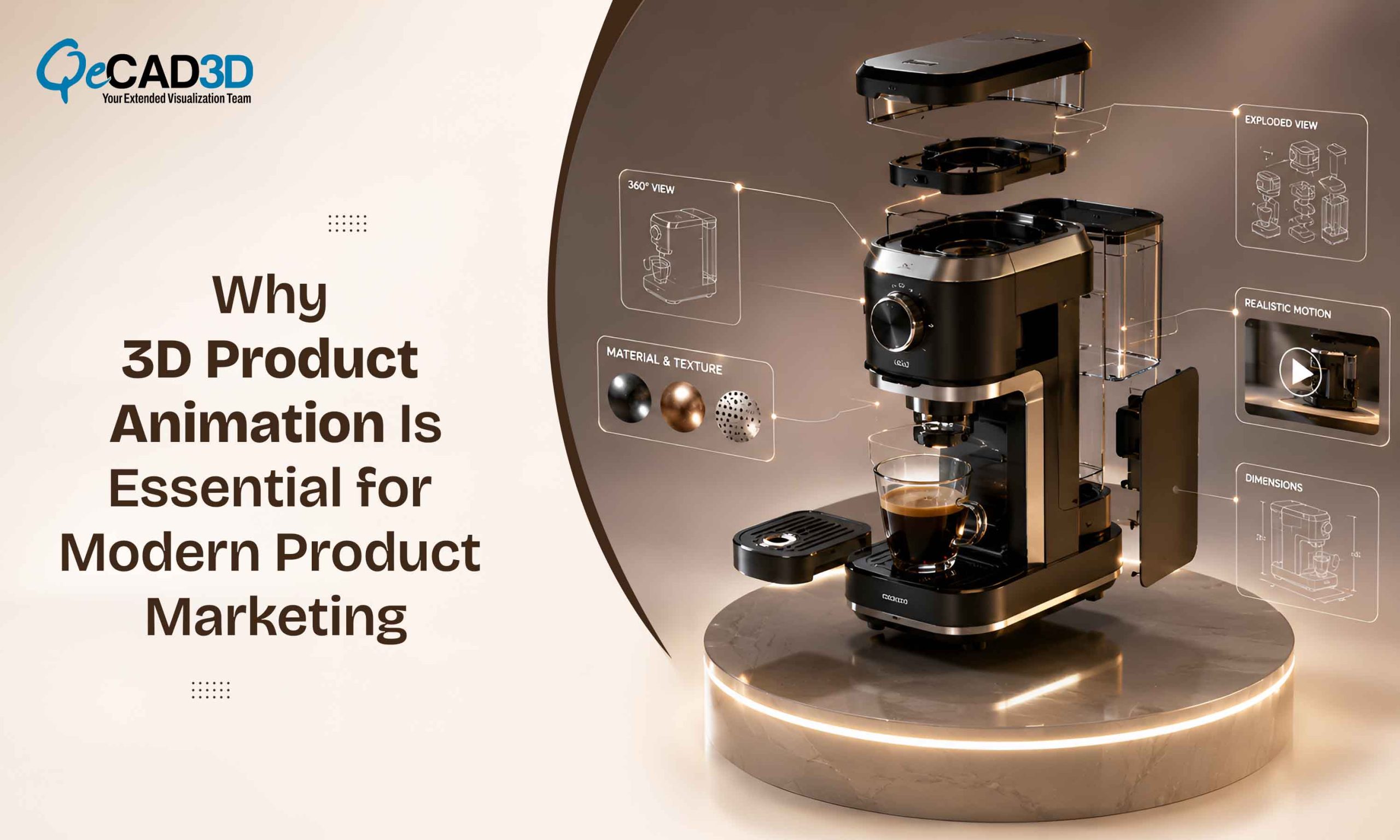
| Exploded/cutaway views | Possible | Difficult or impractical |
| Lighting control | Fully virtual | Controlled physically |
| Lifestyle environments | Digitally constructed | Requires physical set |
| Future updates | Model can be revised | Often requires reshoot |
| Reusability | High | Limited compared with a 3D asset |
The economics also differ. Rendering generally involves greater upfront effort to create the model and materials, while subsequent views and variations can become much easier to generate. Photography typically involves recurring physical production whenever a new variant, angle, or setup is required.
When Does 3D Product Rendering Make Sense?
- The Product Yet to Enter the Production
This is the strongest applications of 3D rendering.
A company can create marketing visuals from approved CAD data before manufacturing the final product. That means product pages, brochures, presentations, advertisements, and launch campaigns can potentially be prepared before physical samples are available.
This is especially valuable for manufacturers launching new equipment, furniture, consumer electronics, appliances, or industrial products.
- The Product Has Multiple Variants
Consider a furniture product available in:
- 6 colors
- 4 materials
- 3 sizes
- 2 configurations
Photographing every combination can quickly become operationally demanding.
With a correctly constructed 3D model, materials, finishes, dimensions, and configurations can be modified digitally. This creates a scalable visual workflow for large product catalogs.
- You Need Views That a Camera Cannot Easily Capture
Some product information is inherently difficult to communicate through conventional photography.
Examples include:
- Exploded views
- Cutaway sections
- Internal components
- Assembly sequences
- Transparent material demonstrations
- Floating components
- Technical close-ups
- Cross-sectional views
3D visualization allows the camera to be positioned virtually around the model and enables components to be separated, hidden, highlighted, or animated.
- You Need Consistent Visuals Across a Catalog
A digital scene can maintain consistent camera positions, lighting, materials, scale, and background treatment across multiple products.
This is particularly useful when a brand wants a standardized visual language across an ecommerce catalog, technical documentation, website, or product brochure.
When Does Product Photography Make More Sense?
- The Physical Product Already Exists
If the product is finalized and only a small number of images are required, photography can be a straightforward solution.
There may be little reason to build a detailed 3D asset when the objective is simply to document the finished item.
- Authentic Material Behaviour Matters
Some materials are challenging to reproduce perfectly in CGI.
Natural stone, food, fabrics, handmade surfaces, organic materials, and products where subtle imperfections contribute to authenticity can benefit from photography.
A camera captures the actual interaction between the physical material, environment, reflections, shadows, and light.
- Human Interaction Is Part of the Story
If the marketing objective is to show how a product fits into everyday life, photography can provide a strong sense of physical context.
For example, a chair being used in a home, a cosmetic product being applied, or sporting equipment being used by an athlete involves human behaviour and environmental cues that may be more naturally communicated through photography.
What About Product Animation?
Static imagery answers “What does the product look like?”
Animation can answer:
“How does it work?”
A 3D animation can rotate a product, demonstrate assembly, reveal internal components, show moving mechanisms, or visualize a product within a specific environment.
This is particularly useful for industrial machinery, engineering products, electronics, medical devices, furniture mechanisms, and technically complex products.
A major advantage is that the same underlying 3D model can potentially support still renders, animations, exploded views, technical presentations, and interactive experiences.
This is where Product Animation Services can become more than a marketing asset—they can function as a visual communication tool for explaining product operation and engineering concepts.
The Hybrid Approach: Why Choose One?
In many projects, the most practical solution is not rendering or photography. It is rendering and photography.
A brand could use:
3D rendering for product variants, ecommerce packshots, technical views, pre-launch visuals, and controlled advertising scenes.
Photography for lifestyle campaigns, human interaction, real-world environments, and authenticity-driven content.
This hybrid approach allows each medium to handle the situations where it has the strongest technical advantage. Current industry comparisons similarly point toward hybrid workflows when brands need both scalable digital assets and authentic physical imagery.
How Should You Decide?
Before choosing a production method, ask five questions:
Does the physical product exist?
If not, 3D rendering may be the practical route.
How many variants are required?
A large number of configurations can make a reusable 3D model increasingly valuable.
How often will the visuals change?
Frequent design, color, packaging, or configuration changes favor a digital asset that can be updated.
Do customers need to see real-world interaction?
If yes, photography may provide stronger context.
Do you need movement or technical explanation?
If the product’s mechanism matters, a 3D animation can communicate information that a static photograph cannot.
The Bottom Line
3D product rendering and product photography are not competing technologies with one universal winner. They solve different visual-production problems.
Photography captures what physically exists.
3D rendering can visualize what exists digitally—or what has not yet been manufactured.
For a single finalized product and authentic lifestyle storytelling, photography can be highly effective. For configurable products, pre-launch campaigns, technical visualization, multiple variants, or reusable digital assets, 3D rendering can offer significantly greater flexibility.
And when the objective is to explain movement, assembly, operation, or internal functionality, animation extends the capabilities of the same digital product model.
The most effective approach is to start with the communication objective, not the production method. Determine what customers need to see, how many visual assets are required, how frequently they will change, and whether the product needs to be shown realistically, technically, or dynamically.
Once those requirements are clear, the choice between a camera, a 3D renderer—or a combination of both—becomes much easier.