
What Makes an Architectural Rendering Look Photorealistic?
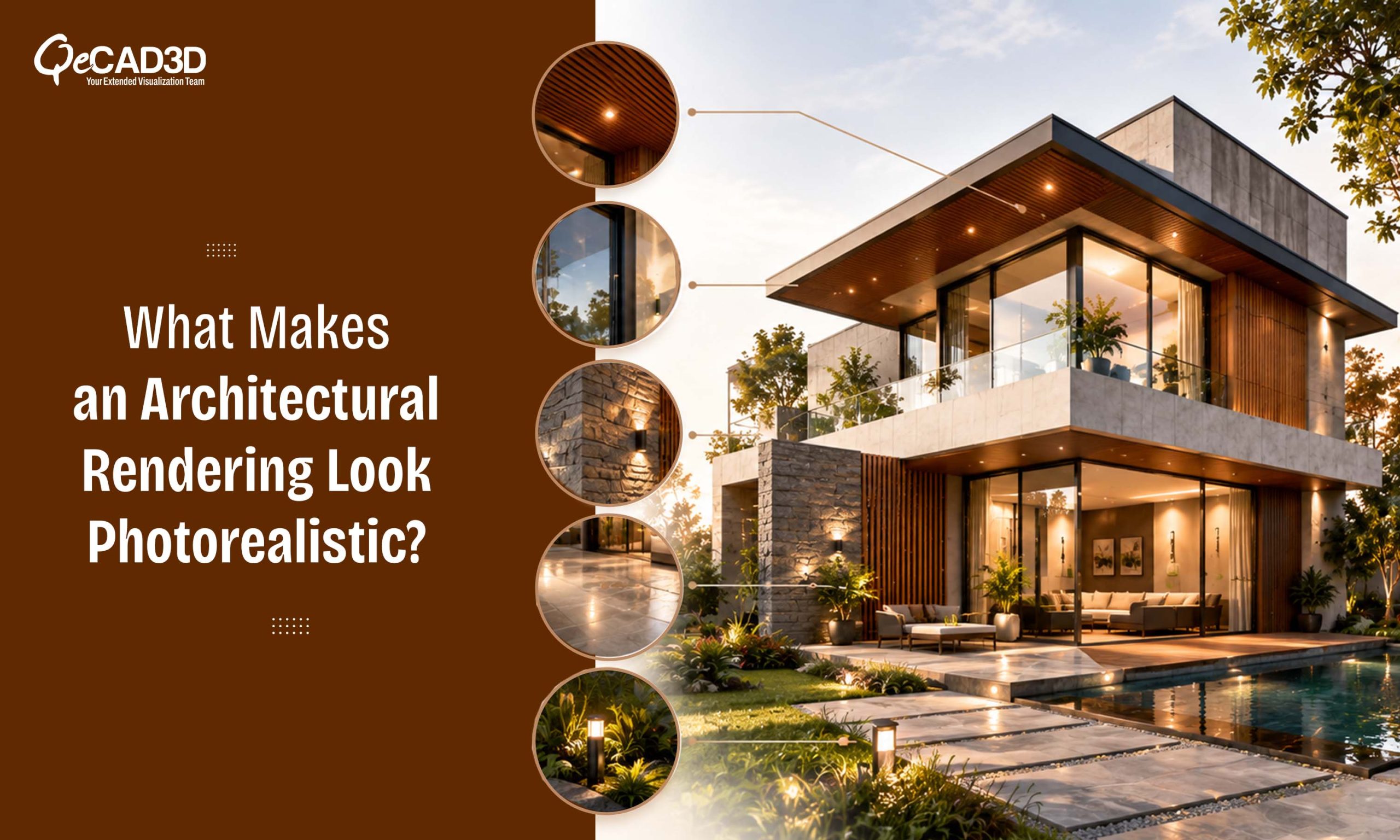
A good architectural rendering does more than showing what a building might look like. It creates a believable visual experience—one where light behaves naturally, materials have physical depth, spaces feel correctly proportioned, and every element appears to belong in the same environment.
Yet two renderings of the same design can look dramatically different. One may feel almost photographic, while another looks obviously computer-generated.
The difference is rarely just about software or rendering resolution. Photorealism comes from how accurately the image reproduces the visual cues our eyes use to interpret the real world.
1. Realism Starts With Accurate Geometry
Before lighting, materials or post-production, there is geometry.
Small inaccuracies in proportions, edges, openings, furniture dimensions, or façade details can immediately make a rendering feel artificial. A window that is slightly too large, a slab that is too thin, or furniture that is incorrectly scaled can disrupt the viewer’s perception of the entire scene.
A realistic workflow therefore begins with a well-developed 3D model.
The level of detail should also correspond to the purpose of the visualization. A conceptual massing image does not require the same geometric detail as a close-up exterior view where façade joints, frames, reveals and surface transitions are clearly visible.
2. Lighting Plays a Critical Role in Realism
Lighting is one of the strongest contributors to perceived realism.
In the real world, light interacts continuously with surfaces, objects, atmosphere, and surrounding buildings. It creates direct illumination, soft shadows, reflections, bounce light, and subtle variations in brightness.
Artificial-looking renders often rely on lighting that is:
- • Too bright or uniformly distributed
- • Excessively sharp
- • Lacking natural shadow variation
- • Poorly balanced between interior and exterior light
- • Missing indirect illumination
Photorealistic rendering requires consideration of the direction, intensity, color temperature and softness of light.
For exterior scenes, the position of the sun can dramatically change the character of a building. Morning and evening light can produce longer shadows and warmer tones, while midday lighting creates shorter, stronger shadows.
The goal is not just to make the building visible. It is to make the lighting behave plausibly.
3. Materials Need More Than a Surface Color
One of the most common reasons a rendering looks artificial is overly simple material treatment.
A real concrete wall isn’t simply “grey.” It contains subtle variations in tone, roughness, pores, imperfections, and reflectivity.
Likewise, glass, timber, stone, metal, fabric, and painted surfaces each interact with light differently.
A realistic material setup considers properties such as:
- • Base color
- • Roughness
- • Reflectivity
- • Transparency
- • Bump or normal detail
- • Surface imperfections
- • Texture scale
Texture scale is particularly important. A brick texture with incorrectly sized joints can make an otherwise accurate building look miniature or digitally generated.
Imperfection matters too. Perfectly clean surfaces with identical patterns rarely exist in the physical world.
4. Reflections and Glass Can Make or Break a Render
Glass is deceptively difficult to represent.
A simple transparent material can make windows appear flat or invisible. Real glass reflects its surroundings while also allowing light to pass through it.
The reflection may reveal the sky, neighbouring buildings, landscape, interior lighting, or nearby objects depending on the viewing angle.
The same principle applies to polished stone, stainless steel, water, and other reflective surfaces.
When reflections are missing—or exaggerated—the material immediately becomes less convincing.
5. Scale Is Communicated Through Context
A building by itself can be difficult to judge.
Adding people, vehicles, vegetation, furniture, doors, railings, and other familiar objects helps communicate scale.
But simply adding entourage isn’t enough.
People should have realistic proportions and appropriate placement. Vehicles should correspond to the architectural context. Trees and plants should have believable sizes and species characteristics.
Poorly scaled entourage can have the opposite effect: it can make an otherwise accurate building look like a miniature model.
6. Camera Composition Changes Perceived Realism
A technically accurate model can still produce an unrealistic image if the camera is poorly positioned.
Architectural visualization often borrows principles from photography:
- • Focal length
- • Camera height
- • Perspective
- • Depth of field
- • Framing
- • Vertical alignment
- • Foreground and background relationships
An excessively wide-angle lens can exaggerate proportions and make spaces feel distorted. A camera positioned too low or too high can also create an unnatural viewpoint.
A good architectural camera usually feels intentional rather than simply placed wherever the model happens to allow it.
7. Vegetation Needs Variation
Landscaping is another area where realism can quickly disappear.
Repeated trees, identical grass textures, perfectly distributed plants, and symmetrical vegetation create visible patterns that do not occur naturally.
Real landscapes contain variation in:
- • Height
- • Density
- • Color
- • Orientation
- • Species
- • Growth patterns
- • Seasonal condition
Vegetation should also respond to the environment. Plants positioned in shadows, for example, should not necessarily appear identical to those exposed to direct sunlight.
8. Imperfection Makes Digital Images Feel Physical
Ironically, one of the secrets to realism is avoiding perfection.
Buildings contain subtle imperfections. Materials weather. Glass gets reflections and slight variations. Edges catch light differently. Surfaces accumulate dirt. Furniture isn’t always perfectly aligned.
These details work best when they remain understated. In fact, they are often most effective when they are barely noticeable.
Photorealism is frequently created through small visual inconsistencies that collectively make the scene feel believable.
9. Post-Processing Should Enhance—Not Rescue—the Render
Post-production can improve an architectural visualization through color correction, exposure adjustments, contrast, atmospheric effects, sharpening, and compositing.
But post-processing cannot fully compensate for poor modelling, lighting, or materials.
Over-processing can create its own problems:
- • Excessive HDR effects
- • Unrealistic saturation
- • Heavy sharpening
- • Artificial bloom
- • Overly dramatic skies
- • Excessive contrast
The strongest results usually come when post-production supports an already convincing render rather than attempting to manufacture realism afterward.
10. Realism Is Also About the Story
A technically flawless render can still feel flat and uninspiring.
Architecture exists in a context, and rendering should communicate how people might experience that environment.
Consider:
Who is using the space?
What time of day is it?
What is happening around the building?
How does the architecture relate to its surroundings?
A residential exterior might benefit from warm interior lighting at dusk. A commercial development might require people and vehicles to communicate activity. A hospitality project might use carefully composed landscaping and lighting to establish atmosphere.
This is where architectural visualization moves beyond technical accuracy and becomes visual communication.
Choosing the Right Rendering Approach
Not every project needs the same level of visual detail.
Early design stages may benefit from faster conceptual images that help teams evaluate massing, materials, and design direction. Marketing campaigns, planning presentations, client approvals, and property launches may require much higher levels of realism.
Professional Architectural Rendering Services typically combine modelling, material development, lighting, camera composition, rendering, and post-production to create visuals suited to the project’s purpose.
For building exteriors, 3D Exterior Rendering Services can help communicate façade design, landscaping, site context, material selections, and the overall character of a development before construction begins.
The Real Secret Behind Photorealism
There is no single “photorealistic” setting that suddenly makes a rendering look real.
Realism is cumulative.
Accurate geometry + physically believable materials + natural lighting + correct scale + thoughtful composition + subtle imperfections + controlled post-production = a convincing architectural image.
The best renderings don’t necessarily draw attention to the technology behind them. Instead, they make the viewer briefly forget that they are looking at a digital image.
That is perhaps the clearest test of architectural realism: when the viewer stops seeing a 3D model and starts seeing a place.