
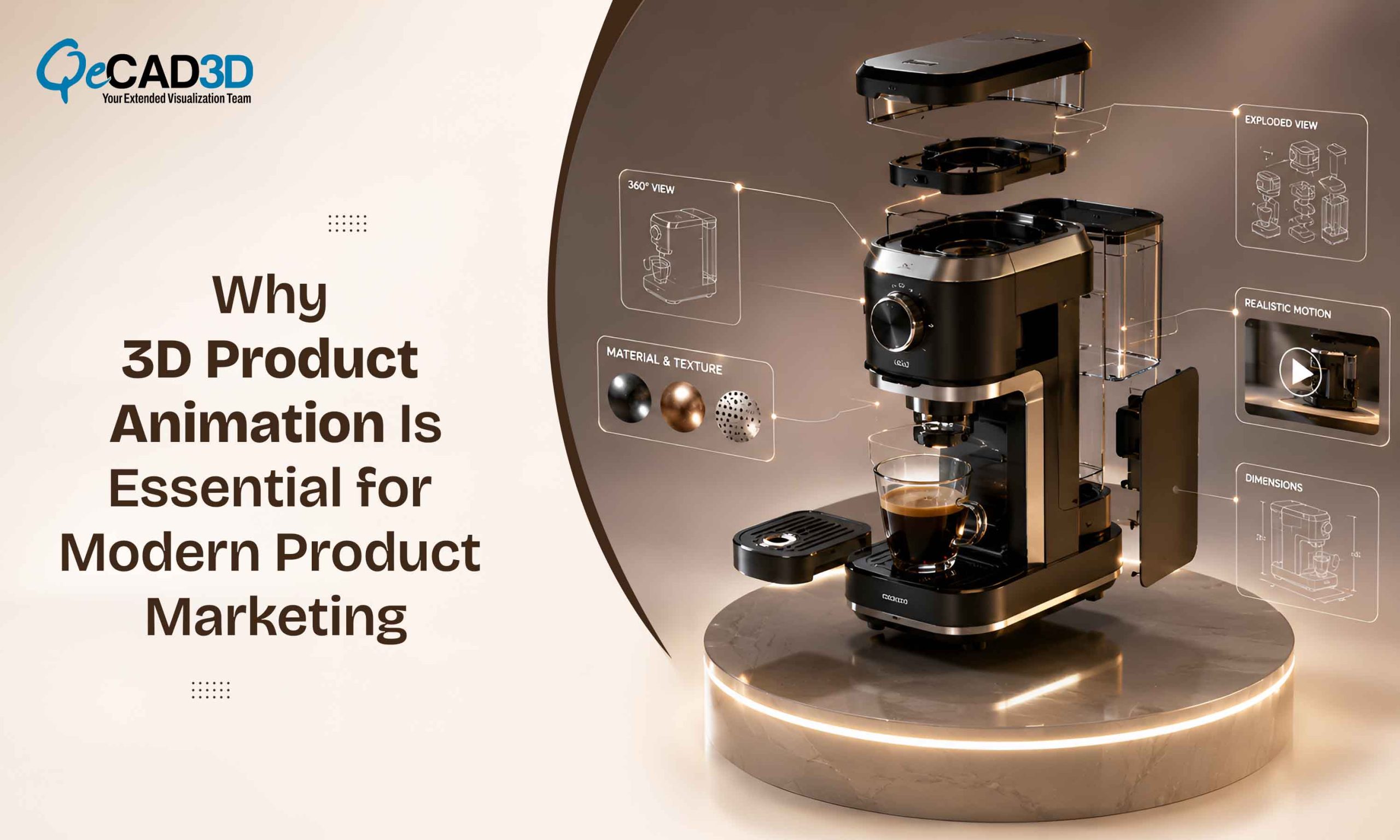
Why 3D Product Animation Is Essential for Modern Product Marketing?
Introduction
In today’s highly competitive digital marketplace, customers expect more than static images and lengthy product descriptions before making a purchase decision. They want to understand how a product looks, functions and delivers value in the real-world scenarios. Traditional product photography often struggles to communicate the complex features, internal mechanisms and product functionality effectively.
This is where Product Animation Services have become an essential marketing and communication tool. By creating realistic, dynamic visual experiences, 3D product animations allows businesses to demonstrate products from every angle, showcase internal components, simulate real-life usage and explain the complex processes with exceptional clarity.
From manufacturing and industrial equipment to consumer electronics, medical devices, furnitures and architectural products, 3D product animation has transformed the way companies educate prospects, engage customers and accelerates buying decisions.
Why Customer Understanding Matters?
Modern customers conduct extensive research before making purchasing decisions. Be it an individual consumers or a set of business buyers, they do seek detailed information that helps them to evaluate:
• Product functionality
• Design quality
• Material finishes
• Installation process
• Performance
• Compatibility
• Maintenance requirements
• Unique selling points
If these aspects remain unclear, customers often postpone purchasing decisions or move to competitors offering better visual communication.
3D animation bridges this information gap by transforming technical specifications into engaging visual stories.
What is 3D Product Animation?
3D product animation comprises of curating realistic moving visualizations of a product using the computer-generated models. Instead of displaying only photographs, animation presents products in motion while demonstrating:
• Product assembly
• Internal mechanisms
• Exploded views
• Rotational views
• Functional demonstrations
• User interactions
• Manufacturing processes
• Installation workflows
Unlike traditional videos, 3D animations can be produced even before the physical prototypes are manufactured, allowing the companies to market products earlier in the development cycle.
How 3D Product Animation Improves Customer Understanding?
- Demonstrates Product Functionality Clearly
Many products contains features that are difficult to explain using text or static images.
Animation allows the businesses to demonstrate:
• Moving components
• Mechanical operations
• Electrical systems
• Automation sequences
• Product workflows
Customers gains an immediate understanding of how the product works thereby reducing the confusion and increasing the confidence.
- Simplifies Complex Technical Information
Industrial machinery, engineering products, HVAC systems, medical equipment and electronic devices often involves complicated mechanisms.
Instead of presenting complex manuals or diagrams, 3D animation visually explains:
• Component interactions
• Operational sequences
• Internal structures
• Material flow
• Mechanical movements
This significantly improves the knowledge retention while making the technical content easier to understand.
- Highlights Product Features More Effectively
One of the greatest strengths of animation is its ability to direct the customer attention towards the specific product features.
Animations can highlight:
• Unique design elements
• Smart functionalities
• Safety mechanisms
• Premium materials
• Innovative engineering
• Hidden components
Strategic camera movements, zoom effects and cross-sectional views ensures that the customers notices the product’s most valuable selling points.
- Visualizes Products Before Manufacturing
Companies frequently need to market the products before the production begins.
Using CAD models or engineering designs, animation enables the businesses to:
• Launch marketing campaigns early
• Collect customer feedback
• Secure investor interest
• Support product pre-orders
• Demonstrate product concepts
This accelerates time-to-market while reducing the dependence on physical prototypes.
Increasing Customer Engagement Through Animation
Captures Attention Faster
Research consistently shows that moving visuals attracts significantly more attention than the static graphics.
Dynamic animations encourage users to:
• Spend more time on websites
• Watch complete demonstrations
• Explore product pages
• Interact with digital content
Longer engagement often leads to higher conversion opportunities.
Improves Storytelling
Customers rarely buy products based solely on technical specifications—they buy solutions.
3D animation allows the brands to build compelling narratives by showing:
• Problems
• Product solutions
• Real-life applications
• Customer benefits
• Performance outcomes
Story-driven presentations creates stronger emotional connections with potential buyers.
Enhances Interactive Learning
Animation supports various customer learning preferences by combining:
• Motion
• Visual cues
• Labels
• Exploded diagrams
• Sequential demonstrations
Instead of reading extensive documentation, customers quickly understand product functionality through intuitive visual communication.
Creates Memorable Brand Experiences
Visually impressive animations leave lasting impressions.
High-quality animations help businesses establish:
• Professionalism
• Technical expertise
• Product innovation
• Brand credibility
• Customer trust
Engaging visual content also increases the likelihood of customers sharing product demonstrations across digital platforms.
Supporting Sales and Marketing Teams
3D product animations provide valuable assets across multiple customer touchpoints.
Sales teams can use animations during:
• Client presentations
• Trade shows
• Product demonstrations
• Virtual meetings
• Investor pitches
Marketing teams benefit by incorporating animations into:
• Websites
• Landing pages
• Social media campaigns
• Digital advertisements
• Email marketing
• Product launch campaigns
The same animation can be repurposed across numerous channels, maximizing return on investment.
Improving E-Commerce Performance
Online buyers cannot physically inspect products before purchasing.
3D animations help overcome this limitation by providing realistic product experiences that improve purchasing confidence.
Benefits includes:
• Better product understanding
• Increased customer trust
• Lower purchase hesitation
• Higher engagement rates
• Reduced product returns due to expectation mismatches
When customers know exactly what they are buying, satisfaction levels generally improve after purchase.
Supporting Technical Training and After-Sales Service
The value of product animation extends beyond marketing.
Organizations also use animations for:
• Installation guidance
• Assembly instructions
• Maintenance procedures
• Operator training
• Safety demonstrations
• Troubleshooting support
Visual learning reduces errors while improving operational efficiency for both customers and service teams.
Integration with Architectural and Design Visualization
Many industries combine product animation with Architectural Rendering Services to showcase products within realistic built environments. Furniture manufacturers, lighting companies, façade system providers, construction product suppliers, and interior product brands frequently demonstrate how their products integrate into architectural spaces. This contextual visualization helps customers better understand scale, functionality, aesthetics, and real-world applications before making purchasing decisions.
Industries Benefiting from 3D Product Animation
The adoption of product animation continues to expand across industries, including:
• Manufacturing
• Industrial equipment
• Consumer electronics
• Medical devices
• Automotive
• Aerospace
• Furniture
• Construction products
• Architecture
• Interior design
• Retail
• Renewable energy
Any industry with products requiring explanation, demonstration, or visualization can benefit from animated presentations.
Best Practices for Effective Product Animation
To maximize customer engagement, businesses should focus on:
• High-quality 3D modeling and realistic materials
• Accurate lighting and reflections
• Smooth camera movements
• Clear storytelling
• Concise animation duration
• Realistic product behavior
• Technical accuracy
• Brand-consistent visual style
• Optimized formats for multiple digital platforms
Combining technical precision with compelling visual storytelling creates animations that both educate and persuade.
Future of 3D Product Animation
Emerging technologies such as real-time rendering, artificial intelligence, virtual reality (VR), augmented reality (AR), and interactive 3D experiences are reshaping product visualization.
Future product animations will become increasingly immersive, allowing customers to:
• Interact with products in real time
• Customize product configurations
• Explore products through AR devices
• Experience realistic simulations before purchasing
These advancements will continue to improve customer understanding while creating more engaging digital buying experiences.
Conclusion
With the increasing customer expectations, businesses must communicate product value with greater clarity and impact. Static visuals alone are no longer sufficient for explaining sophisticated products or capturing attention in a crowded digital landscape. 3D product animation offers an effective way to simplify technical information, demonstrate functionality, build trust, and create memorable customer experiences.
Organizations that invest in high-quality product animation are better positioned to educate their audiences, strengthen engagement, support sales efforts, and improve conversion rates. By transforming complex products into clear and compelling visual narratives, 3D animation has become an indispensable tool for modern product marketing and customer communication.