
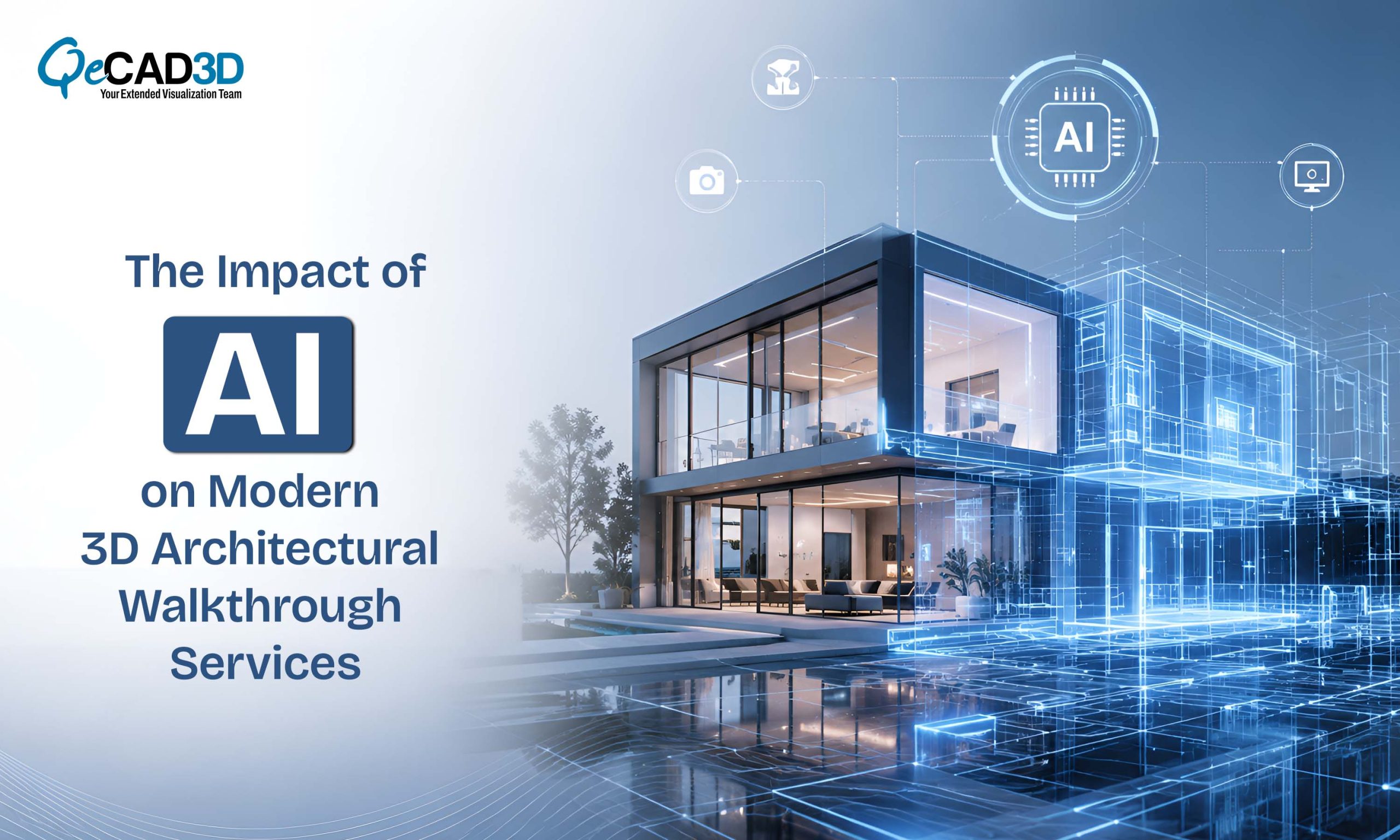
The Impact of AI on Modern 3D Architectural Walkthrough Services
Introduction
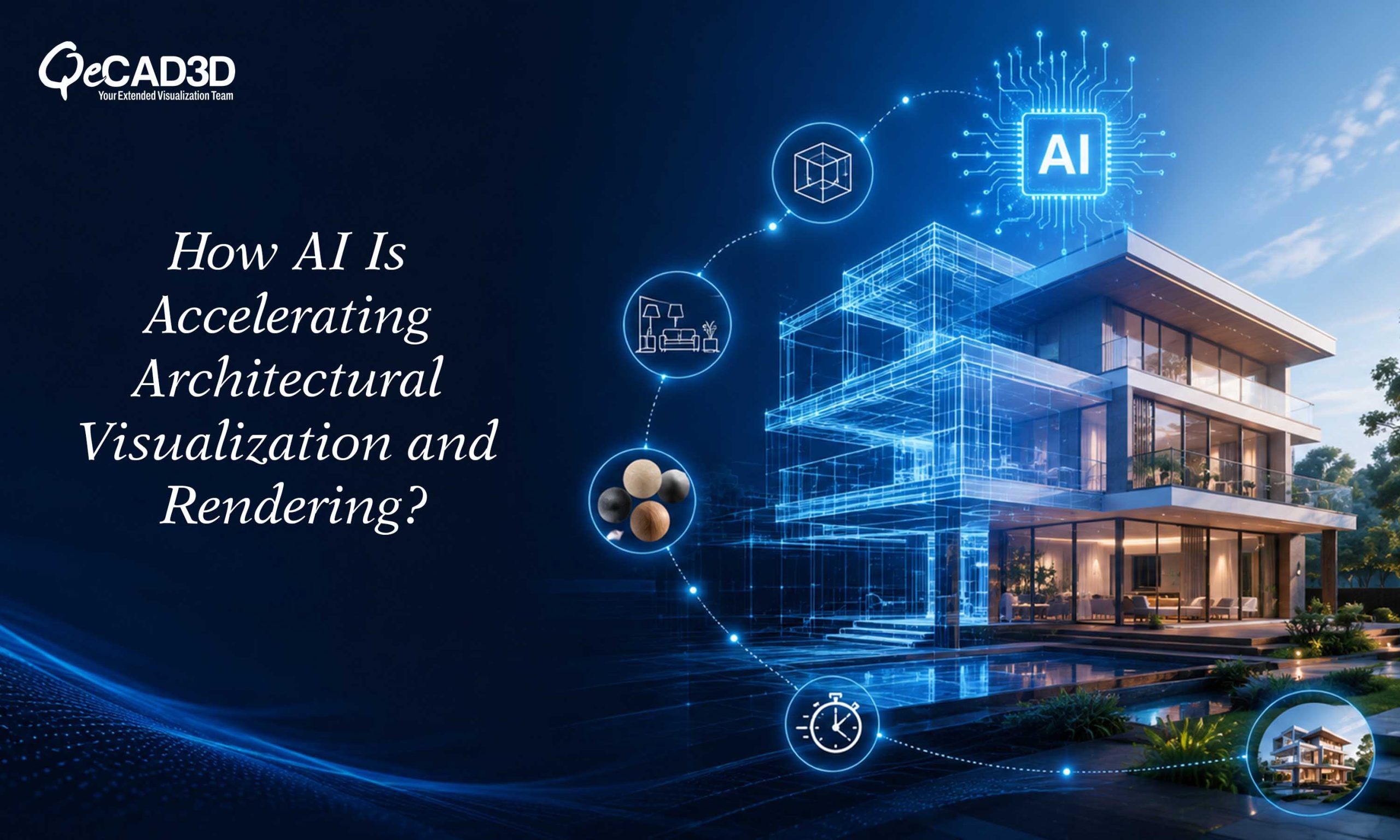
Architectural visualization has undergone remarkable transformation in recent years. What was once a time-intensive process involving manual modeling, rendering, animation and post-production has now become far more intelligent through AI. Today, AI is transforming how architects, developers, designers and visualization studios create immersive architectural walkthroughs, enabling faster production, improved realism and more informed design decisions.
Unlike traditional automation, AI augments the creative workflow by accelerating repetitive tasks, optimizing rendering processes, generating realistic environments and enhancing visual quality without compromising design intent. As demand grows for highly detailed virtual presentations during project planning and marketing, AI has become an essential technology for delivering advanced Walkthrough Services that are both efficient and visually compelling.
Why Architectural Walkthroughs Matter?
Architectural walkthroughs allows the stakeholders to experience a building before the construction begins. Instead of interpreting static floor plans or elevations, clients can virtually navigate the interiors and exteriors, understand spatial relationships, evaluate material finishes and visualize lighting conditions.
These immersive experiences helps to:
• Improve client understanding
• Support design approvals
• Reduce design revisions
• Strengthen project presentations
• Enhance marketing and property sales
• Improve investor confidence
As project complexity increases, expectations for realism and speed have also grown—making AI a natural fit for modern visualization workflows.
How AI Is Changing Architectural Walkthrough Creation?
- Intelligent Scene Generation
Creating detailed environments traditionally required extensive manual efforts. AI now assists artists by automatically generating surrounding landscapes, vegetation, roads, urban elements, furniture layouts and environmental assets.
Instead of modeling every object individually, AI can populate scenes while maintaining consistency with project context, allowing visualization teams to focus more on design refinement than repetitive asset placement.
Benefits includes:
• Reduced production time
• Consistent scene composition
• Faster environment creation
• Improved scalability for large developments
- Faster Material and Texture Creation
Realistic materials are essential for believable architectural walkthroughs.
AI-powered material generation tools can automatically create or enhance:
• Wood textures
• Concrete finishes
• Metal surfaces
• Glass reflections
• Fabric materials
• Stone patterns
Many AI systems can also upscale low-resolution textures while preserving fine surface details, resulting in photorealistic finishes with significantly less manual editing.
- AI-Assisted Lighting Optimization
Among all visualization elements, lighting is one of the most complex factors influencing the realism and atmosphere of a scene.
AI can analyze:
• Natural daylight conditions
• Sun positioning
• Interior illumination
• Shadow behavior
• Reflection intensity
• Color balance
Instead of relying solely on trial-and-error adjustments, AI recommends optimized lighting setups that improve realism while reducing rendering iterations.
This creates walkthroughs that more accurately represent how spaces will appear throughout different times of the day.
- Accelerated Rendering Workflows
Rendering high-resolution animation sequences has traditionally been one of the longest stages in walkthrough production.
AI-based rendering technologies now utilize:
• Intelligent denoising
• Predictive sampling
• Adaptive rendering
• Frame interpolation
• Noise reduction algorithms
These capabilities dramatically shorten rendering times while maintaining high image quality.
Visualization studios can therefore produce more animation sequences within tighter project schedules.
- Smarter Camera Path Generation
Creating smooth and engaging walkthrough animations requires carefully planned camera movements.
AI can automatically analyze architectural geometry and recommend:
• Natural navigation paths
• Camera heights
• Viewing angles
• Transition speeds
• Focal points
This reduces manual animation work while producing walkthroughs that feel intuitive and cinematic.
The result is a more immersive experience that effectively communicates the project’s design intent.
- Realistic Environmental Simulation
Modern architectural presentations go beyond static buildings.
AI enables dynamic simulation of:
• Moving vehicles
• Pedestrians
• Trees responding to wind
• Water movement
• Cloud behavior
• Weather conditions
These subtle environmental elements significantly increase realism and make virtual spaces feel alive.
- Automated Post-Production Enhancement
After rendering, AI streamlines post-production through automated image and video enhancement.
AI tools can perform:
• Color correction
• Exposure balancing
• Motion stabilization
• Depth enhancement
• Noise removal
• Resolution upscaling
This minimizes manual editing while maintaining consistent quality across lengthy animation sequences.
- AI-Powered Object Recognition and Asset Management
Large visualization projects often contain thousands of assets.
AI helps organize and categorize:
• Furniture
• Fixtures
• Building components
• Decorative objects
• Landscape assets
Smart asset management improves search efficiency, maintains project consistency, and reduces duplication across multiple visualization projects.
- Predictive Design Visualization
One of AI’s emerging capabilities is predictive visualization.
AI can analyze design data and suggest:
• Material alternatives
• Interior styling options
• Landscape improvements
• Lighting adjustments
• Furniture arrangements
These suggestions allow architects and designers to evaluate multiple design scenarios more quickly, supporting better decision-making during concept development.
- Personalized Client Experiences
AI is making architectural walkthroughs increasingly interactive.
Future AI-powered walkthroughs can adapt based on user preferences, allowing clients to:
• Change materials instantly
• Compare design options
• Switch furniture styles
• Explore different lighting conditions
• Experience seasonal variations
This level of personalization improves client engagement while accelerating design approvals.
Key Benefits of AI in Architectural Walkthrough Creation
Organizations adopting AI-driven visualization workflows benefit from:
• Faster project delivery
• Improved rendering efficiency
• Higher visual realism
• Reduced production costs
• Better design communication
• Enhanced client presentations
• Greater consistency across projects
• Increased creative flexibility
• Faster design iterations
• Improved stakeholder engagement
These advantages help firms remain competitive in an industry where speed and visualization quality increasingly influence project success.
Challenges That Still Require Human Expertise
Although AI significantly enhances production efficiency, it does not replace skilled visualization professionals.
Human expertise remains essential for:
• Architectural interpretation
• Design storytelling
• Creative composition
• Client communication
• Artistic direction
• Brand consistency
• Technical accuracy
• Final quality assurance
The most successful workflows combine AI-powered automation with experienced artists who understand architectural design principles and visual communication.
The Future of AI-Driven Architectural Walkthroughs
The next generation of architectural walkthroughs will become even more intelligent through advancements in generative AI, real-time rendering, digital twins, and extended reality (XR). AI will continue to reduce production time while enabling increasingly immersive, interactive, and data-driven visualization experiences.
As these technologies mature, architectural walkthroughs will evolve from presentation tools into collaborative environments where architects, engineers, contractors, and clients can evaluate designs, simulate project scenarios, and make informed decisions before construction begins.
Organizations partnering with an experienced 3D Rendering Company that effectively integrates AI with skilled visualization expertise will be better positioned to deliver engaging architectural experiences that meet the growing expectations of today’s AEC industry.
Conclusion
Artificial intelligence is fundamentally reshaping the way architectural walkthroughs are created. From intelligent scene generation and accelerated rendering to realistic environmental simulation and interactive visualization, AI enables faster workflows without compromising visual quality. Rather than replacing creativity, it empowers architects and visualization professionals to focus on design innovation, storytelling, and client engagement. As AI technologies continue to advance, firms that embrace these capabilities will be able to produce more immersive, accurate, and impactful architectural walkthroughs, setting new standards for design communication and project visualization.