
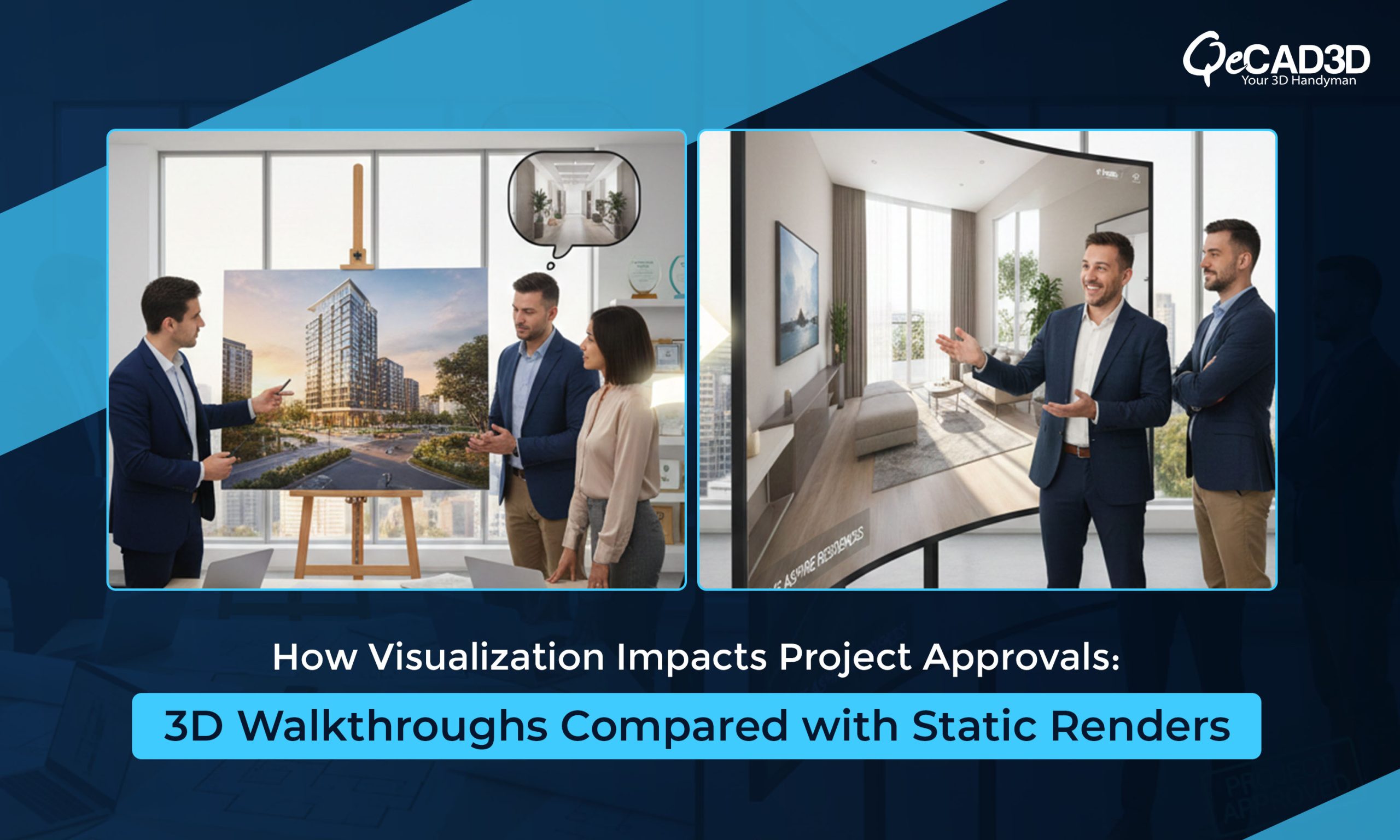
How Visualization Impacts Project Approvals: 3D Walkthroughs Compared with Static
In today’s design and construction landscape, visual communication plays a decisive role in how quickly and effectively a project moves from the concept to approval. Planning authorities, investors, developers and internal stakeholders no longer rely solely on the drawings and written descriptions. Instead, high-quality visualizations are now an essential part of the approval process.
Among the most widely used visualization tools are 3D walkthroughs and static renders. While both serve the same overarching purpose—helping reviewers understand the proposed design—their impact on the project approvals differs significantly depending on the context, audience and project complexity.
This blog explores the technical differences, strengths and limitations of both formats to help you determine which option works better for your approval requirements.
Understanding the Role of Visuals in Project Approvals
Project approvals often involves stakeholders with varying levels of technical expertise. While architects and engineers may easily interpret the plans and sections, decision-makers, investors and regulatory bodies typically prefer visual clarity over the technical detail.
Effective visual tools helps:
- Reduce misinterpretation of the design intent
- Address concerns related to the massing, scale and spatial relationships
- Accelerate feedback cycles
- Minimize revision requests during the approval stages
Both static renders and walkthroughs address these needs—but in different ways.
What Are Static Renders?
Static renders are high-resolution, photorealistic images created from a 3D model, showcasing the specific views of a project. These typically includes exterior perspectives, interior spaces, key amenities and contextual shots.
Technical Strengths of Static Renders
- High visual fidelity: Detailed materials, lighting, reflections and textures can be finely controlled.
- Targeted storytelling: Each image is carefully composed to highlight a particular design feature or selling point.
- Faster review process: Approval bodies can quickly assess the specific aspects without navigating a sequence or animation.
- Cost-effective for early approvals: Requires less production time compared to the animated content.
Limitations in Approval Scenarios
- Fixed viewpoints may not fully explain the spatial relationships
- Multiple images may still leave room for interpretation
- Less effective for complex layouts or circulation-heavy designs
Static visuals forms the backbone of most approval submissions and are a key component of the professional 3D Rendering Services, especially during the early design and statutory approval stages.
What Is a 3D Walkthrough?
A 3D walkthrough is an animated or interactive visualization that guides the viewer through the project as if they are physically moving through the space. It demonstrates spatial flow, transitions and scale in real time.
Technical Strengths of 3D Walkthroughs
- Clear spatial understanding: Movement through the model eliminates the ambiguity around the circulation and layout.
- Realistic experience: Viewers can understand scale, height, depth and proportions more intuitively.
- Stronger stakeholder engagement: Ideal for non-technical reviewers and decision-makers.
- Reduced back-and-forth: Fewer clarification requests due to comprehensive visual explanation.
Limitations in Approval Scenarios
- Longer production time and higher cost
- Harder to revise once finalized
- Reviewers may focus more on aesthetics than on compliance if not guided properly
For large developments, mixed-use projects or high-value approvals, 3D Walkthrough Services often provide a more persuasive and immersive presentation.
Approval Stage Comparison: Which Works Better and When?
1) Concept & Early Planning Approvals
Static renders are very much effective at this stage. Approval authorities focuses on massing, setbacks, height, façade treatment and contextual impact. Carefully selected views communicates these aspects clearly without any unnecessary complexity.
Best choice: Static renders
2) Design Development & Stakeholder Buy-In
When the internal teams, investors or joint development partners need to align on a design, walkthroughs offer a clearer understanding of spatial logic and user experience.
Best choice: 3D walkthrough
3) Council, Planning Authority & Public Consultations
For complex developments where the objections or misunderstandings are likely, walkthroughs helps in eliminating the doubt by visually explaining how the project fits within its surroundings and functions in real life.
Best choice: Combination of both
4) Final Approvals & Marketing-Driven Submissions
At advanced stages, a walkthrough can support final approvals while also being repurposed for marketing, presentations and investor decks—delivering long-term value beyond approvals.
Best choice: 3D walkthrough with supporting static views
Key Technical Factors That Influence Approval Success
| Factor | Static Renders | 3D Walkthrough |
| Clarity of design intent | High (view-specific) | Very high (holistic) |
| Time to produce | Faster | Longer |
| Cost efficiency | More economical | Higher investment |
| Ease of revisions | Easier | More complex |
| Stakeholder engagement | Moderate | Very high |
| Suitability for complex layouts | Limited | Excellent |
The Most Effective Strategy: Use Both Together
In practice, the most successful approval submissions rarely rely on a single visualization format. Static renders provide precision and control, while the walkthroughs delivers the context and experience. Used together, they create a compelling, technically sound narrative that satisfies both the regulatory requirements along with the stakeholder expectations.
Rather than choosing one over the other, project teams should evaluate:
- Project scale and complexity
- Approval authority expectations
- Timeline constraints
- Budget and long-term reuse potential
Conclusion
There is no single, definitive answer to whether a 3D walkthrough or static renders works better for project approvals. Each serves a distinct purpose and excels at different stages of the approval journey.
Static renders remain indispensable for clarity, compliance and efficiency, while walkthroughs offer unmatched spatial understanding and engagement. When aligned with the right approval stage and audience, both tools significantly reduces the approval risks and improves the decision-making confidence.
Ultimately, the most effective approach is not choosing between them—but strategically integrating both to support a smoother, faster, and more informed approval process.