
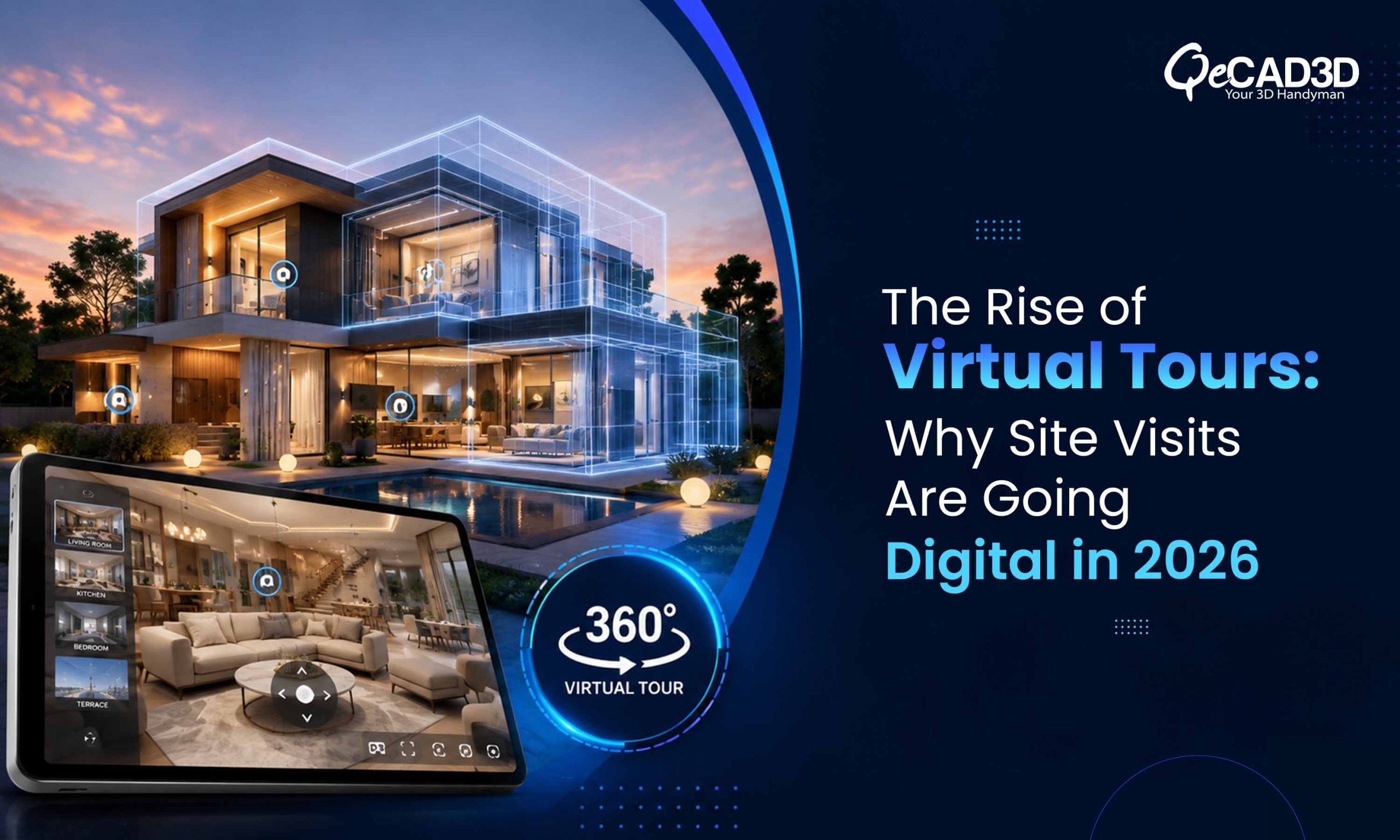
The Rise of Virtual Tours: Why Site Visits Are Going Digital in 2026
The way people explore spaces has changed dramatically in recent years. In 2026, virtual tours are no longer considered an optional marketing feature — they have become a core business tool across the real estate, architecture, construction, hospitality and commercial property sectors.
From residential buyers reviewing the properties remotely to global investors inspecting the commercial developments digitally, businesses are increasingly replacing the physical site visits with immersive virtual experiences. Powered by VR, BIM, AI, digital twins and cloud-based visualization technologies, virtual tours are redefining how the projects are presented, reviewed and approved.
Today’s clients want faster decision-making, remote accessibility and highly interactive experiences. Virtual tours are delivering exactly that.
The Shift from Physical to Digital Experiences
Traditional site visits often involves travel costs, scheduling delays, logistical coordination and limited accessibility. In contrast, the virtual tours allows the stakeholders to explore the spaces instantly from anywhere in the world.
According to recent industry reports:
- ● 87% of homebuyers now expect virtual tours in property listings.
- ● Listings comprising of virtual tours gets 87% more views.
- ● Properties showcasing immersive tours can sell up to 20% faster.
- ● 95% of buyers are more likely to engage with property listings that features interactive 360° experiences.
These numbers clearly indicates that the digital property experiences are becoming a standard expectation rather than just a competitive advantage.
The growth of AR/VR technologies is also accelerating this transformation. Industry reports estimates that the global AR/VR ecosystem reached nearly USD 118 billion in 2026, driven heavily by real estate, construction and infrastructure applications.
Why Virtual Tours Are Becoming the Preferred Choice?
- Remote Accessibility Without Geographic Limits
A major factor driving this growing trend of virtual tours is accessibility. International buyers, remote investors, consultants and project stakeholders can now inspect spaces without traveling physically.
In regions like the UAE, international buyers reportedly account for over 65% of off-plan property purchases, many of whom finalize decisions through VR-based walkthroughs before visiting the site in person.
This convenience significantly reduces the project delays and speeds up the approvals.
- Faster Decision-Making
Virtual tours provides instant visualization of spaces, layouts, materials and design intent. Clients no longer needs multiple site visits to understand the project.
Interactive walkthroughs now allows users to:
- ● Navigate spaces freely
- ● View alternate design options
- ● Experience realistic lighting conditions
- ● Explore furniture layouts
- ● Understand room connectivity and spatial flow
These immersive experiences helps the stakeholders to make informed decisions much faster than the static drawings or photographs.
- Cost and Time Efficiency
Physical visits often involve:
- ● Travel expenses
- ● Coordination costs
- ● On-site safety arrangements
- ● Delayed scheduling
Virtual walkthroughs eliminates many of these challenges.
For developers and architects, this means:
- ● Reduced presentation costs
- ● Faster sales cycles
- ● Fewer unnecessary site visits
- ● Improved productivity
Luxury real estate studies shows that properties marketed with the VR tours can sell 35–44% faster while achieving higher engagement levels from serious buyers. (Core Insights Review)
The Role of Technology in 2026 Virtual Tours
The virtual tour ecosystem in 2026 is far more advanced than simple panoramic images used a few years ago.
Modern virtual experiences combine:
- ● Real-time rendering engines
- ● AI-enhanced visualization
- ● BIM-integrated digital twins
- ● Drone-based site scanning
- ● LiDAR technology
- ● Cloud streaming
- ● Interactive VR environments
These technologies create immersive environments where users can experience unfinished projects as fully functional spaces.
This is particularly valuable for:
- ● Architectural presentations
- ● Construction progress reviews
- ● Real estate pre-sales
- ● Interior design approvals
- ● Facility management planning
Businesses offering advanced 360 Virtual Tour Services are increasingly helping the clients to bridge the gap between the conceptual designs and real-world understanding.
Virtual Tours in Architecture and Construction
The AEC industry is witnessing major adoption of VR and AR technologies alongside BIM workflows.
Research studies indicate that VR integration significantly improves:
- ● Design understanding
- ● Coordination accuracy
- ● Quality assurance
- ● Stakeholder collaboration
- ● Construction training efficiency
Architects and engineers can now present the projects through immersive environments instead of relying solely on 2D drawings or rendered images.
This has transformed client presentations, especially for:
- ● Smart buildings
- ● Infrastructure projects
- ● Commercial developments
- ● Industrial facilities
- ● Healthcare architecture
In many cases, virtual experiences are reducing the need for repetitive on-site meetings during early project phases.
Buyer Psychology and Consumer Expectations
Consumer behaviour has evolved rapidly after years of digital-first experiences.
Modern buyers prefer:
- ● Convenience
- ● Speed
- ● Transparency
- ● Self-guided exploration
Virtual tours satisfy all these expectations.
Interestingly, discussions across real estate communities also reveals that the buyers appreciate the virtual walkthroughs because they help them to better understand spatial relationships and room flow before committing to physical visits. (Reddit)
Rather than just replacing the human interaction entirely, virtual tours are filtering serious buyers from casual inquiries thereby improving sales the efficiency for businesses.
Are Physical Site Visits Completely Disappearing?
Not entirely.
For high-value investments, final inspections and physical walkthroughs still remains important. However, what has changed is when the physical visits occurs.
In 2026:
- ● Virtual tours handle the initial discovery phase
- ● Digital walkthroughs supports the design approvals
- ● Remote collaboration happens virtually
- ● Physical visits occurs only at critical decision stages
This hybrid approach saves time while improving the project communication and customer engagement.
The Future of Virtual Site Experiences
The future of virtual tours is moving towards intelligent, interactive digital ecosystems powered by AI and spatial computing.
Emerging innovations includes:
- ● AI-guided virtual assistants
- ● Real-time customization of interiors
- ● Live collaboration inside VR spaces
- ● Interactive BIM-linked walkthroughs
- ● Multi-user remote inspections
- ● Immersive facility management systems
As technologies becomes more affordable and accessible, virtual experiences will continue replacing the traditional viewing methods across industries.
Businesses investing in advanced Walkthrough Services today are positioning themselves ahead of a rapidly evolving digital market.
Conclusion
Virtual tours are no longer just marketing enhancements — they are becoming essential business infrastructure in 2026.
The combination of immersive visualization, remote accessibility, faster decision-making and improved customer engagement is fundamentally changing how spaces are explored and approved.
From real estate developers and architects to construction firms and interior designers, organizations are embracing virtual experiences to reduce costs, accelerate workflows and deliver better client experiences.
While physical site visits will still play a role in final evaluations, the first impression — and often the most influential one — is increasingly happening in a virtual environment.