
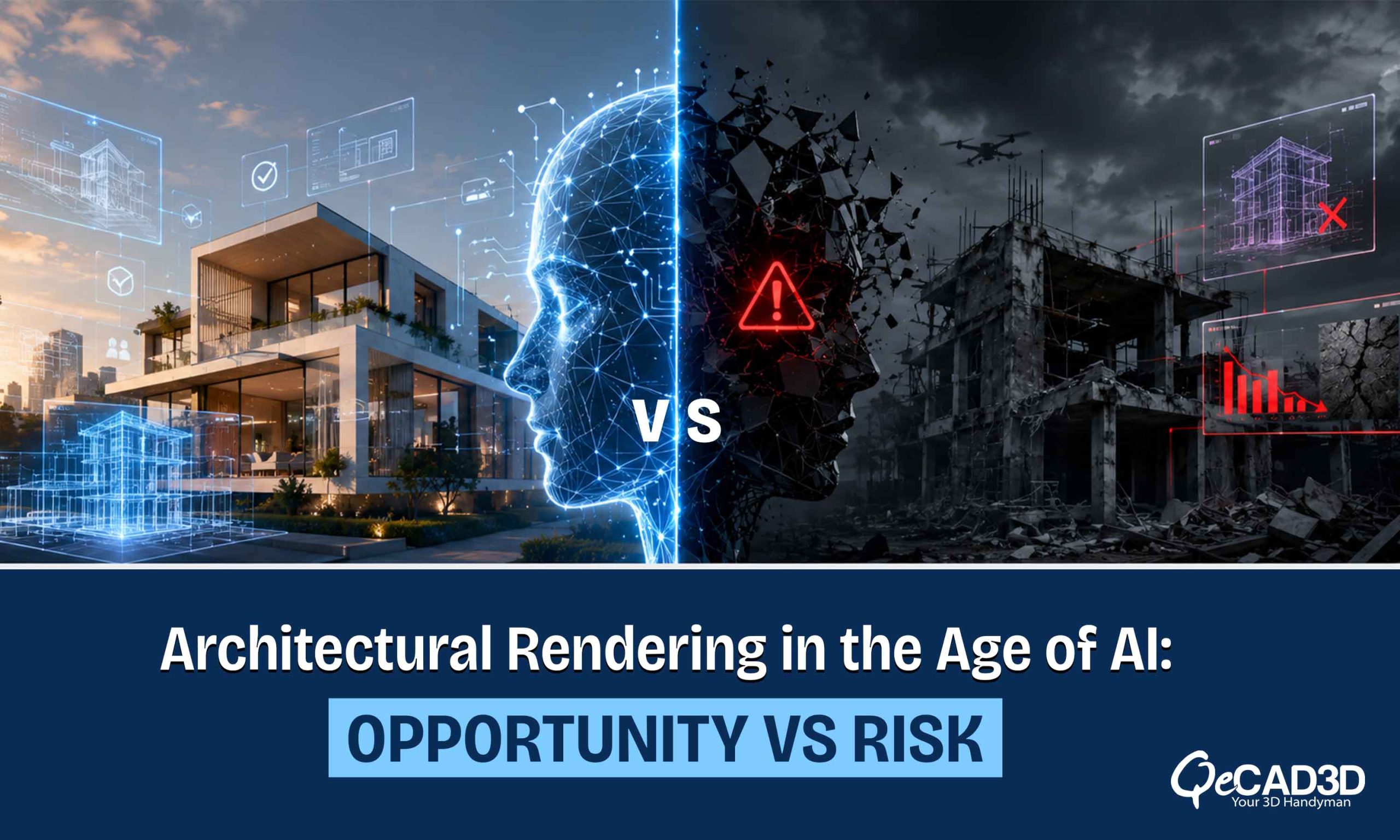
Architectural Rendering in the Age of AI: Opportunity vs Risk
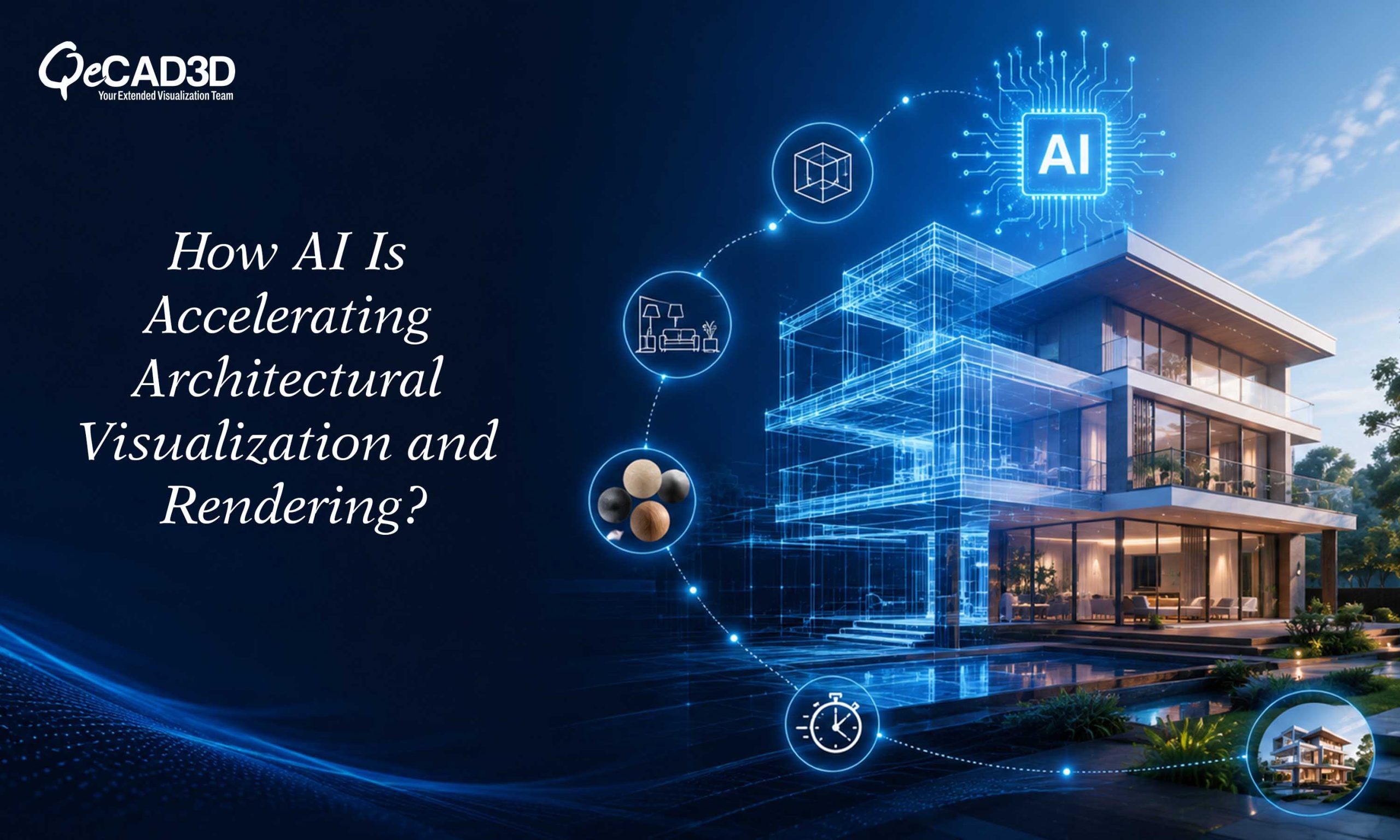
The architectural visualization industry is experiencing a major transformation with the rapid integration of Artificial Intelligence (AI). From generating conceptual visuals within seconds to automating the post-production tasks, AI is redefining how the architectural renderings are created, reviewed and presented.
What once required days of manual modeling, lighting adjustments and rendering iterations can now be accelerated using AI-powered tools and workflows. But while the advantages are significant, many architects, designers and visualization firms are also questioning the long-term implications.
Is AI enhancing creativity and productivity — or introducing risks that compromises originality, technical accuracy and professional reliability?
The answer lies somewhere in between.
The Expanding Influence of AI in Architectural Rendering
AI is no longer limited to experimental tools. It is actively being integrated into the rendering workflows across architecture, interior design, real estate marketing and urban planning.
Today, AI can assist with:
- ● Concept visualization
- ● Material and texture generation
- ● Lighting optimization
- ● Image enhancement
- ● Style transformation
- ● Background generation
- ● Automated staging
- ● Faster rendering outputs
- ● Design variations based on prompts
These capabilities are helping visualization teams to reduce repetitive tasks and focus more on the design thinking and client communication.
For firms offering Architectural Rendering Services, AI has become a strategic tool for improving the turnaround times and increasing the visual production capacity without proportionally increasing the manual effort.
How AI Enhances Architectural Rendering?
- Faster Concept Development
Architects often needs to communicate the ideas during the early design phase when the detailed models may not yet exist. AI-powered visualization tools can rapidly generate the conceptual images from sketches, prompts or rough geometry.
This allows:
- ● Faster client approvals
- ● Improved design discussions
- ● Early-stage visualization support
- ● More iterations within shorter timelines
Instead of spending the days building preliminary scenes, teams can present the visual directions within hours.
- Improved Rendering Efficiency
Traditional rendering workflows involves time-intensive processes such as:
- ● Material mapping
- ● Lighting calibration
- ● Environment setup
- ● Post-production editing
AI can automate many of these repetitive tasks thus helping the visualization artists to focus on refinement rather than just the basic corrections.
Examples includes:
- ● Automatic denoising
- ● Intelligent upscaling
- ● Realistic shadow generation
- ● AI-assisted texture suggestions
- ● Scene enhancement
This significantly reduces the production timelines while maintaining the visual quality.
- Enhanced Client Visualization
Clients often struggle to interpret technical drawings or unfinished 3D models. AI-enhanced renderings can produce highly immersive visuals that make design intent easier to understand.
For residential and commercial projects, realistic visualization helps clients:
- ● Experience spaces emotionally
- ● Understand lighting and atmosphere
- ● Evaluate finishes and materials
- ● Make faster decisions
This is especially valuable in Interior Rendering Services, where mood, ambiance, furniture styling and material aesthetics play a critical role in the final presentation.
- Creative Exploration and Design Variations
AI tools can generate multiple stylistic interpretations of the same concept almost instantly.
Architects and designers can explore:
- ● Alternative facades
- ● Interior themes
- ● Lighting moods
- ● Landscape styles
- ● Furniture arrangements
This expands creative possibilities and supports more collaborative brainstorming sessions between teams and clients.
The Risks and Challenges of AI in Rendering
While AI offers substantial advantages, relying on it without professional oversight introduces several risks.
- Accuracy Concerns
One of the biggest concerns with AI-generated visuals is technical accuracy.
AI-generated renderings may:
- ● Misrepresent dimensions
- ● Create unrealistic structural elements
- ● Ignore construction feasibility
- ● Produce incorrect material behavior
- ● Distort geometry
In architecture, visuals are not just artistic outputs — they are communication tools tied closely to real-world construction. A visually appealing image that lacks technical credibility can create misunderstandings, rework, or client dissatisfaction.
Human expertise is much needed to validate every rendering output.
- Loss of Design Authenticity
AI systems learn from existing visual datasets. As a result, there is a growing concern that over-reliance on AI could lead to repetitive aesthetics and generic architectural styles.
Design originality may suffer when:
- ● AI-generated concepts dominate early ideation
- ● Teams rely heavily on preset styles
- ● Visualization becomes trend-driven instead of concept-driven
Architecture is deeply contextual and human-centered. Creativity rooted in culture, climate, function, and emotion cannot be fully replaced by algorithmic generation.
- Ethical and Copyright Issues
AI-generated imagery raises important questions regarding:
- ● Ownership of generated visuals
- ● Use of copyrighted datasets
- ● Replication of artistic styles
- ● Intellectual property rights
Many AI tools are trained on publicly available images, which may include copyrighted architectural works and visualization portfolios.
Firms using AI commercially must remain cautious about legal and ethical implications surrounding generated content.
- Reduced Human Skill Development
As automation increases, there is concern that younger visualization professionals may become overly dependent on AI tools instead of developing foundational skills.
Core expertise such as:
- ● Composition
- ● Lighting theory
- ● Material realism
- ● Perspective understanding
- ● Spatial storytelling
still requires human learning and artistic judgment.
AI should assist professionals — not replace the need for technical and creative mastery.
Finding the Right Balance
The future of architectural rendering is unlikely to be fully AI-driven or fully manual. Instead, the industry is moving towards a hybrid approach where AI enhances the workflows while professionals retain the creative and technical control.
The most effective visualization teams will be those that:
- ● Use AI strategically
- ● Maintain quality control processes
- ● Prioritize design intent
- ● Combine automation with human creativity
- ● Ensure technical accuracy in every output
AI can accelerate production, but architectural understanding, storytelling and contextual thinking remains fundamentally human strengths.
The Future of AI in Architectural Visualization
AI will continue to evolve rapidly in the coming years. We can expect advancements in:
- ● Real-time rendering
- ● Interactive AI-assisted walkthroughs
- ● Automated scene generation
- ● Personalized client visualization
- ● Predictive material and lighting simulations
However, clients will continue to value authenticity, expertise, and precision — qualities that cannot be fully automated.
The role of visualization professionals will evolve from simply producing renderings to directing intelligent creative workflows that combine technology with architectural insight.
Conclusion
AI is undeniably transforming the architectural rendering workflows. It offers the faster production, improved efficiency, enhanced creativity and better client engagement. At the same time, it introduces challenges related to accuracy, originality, ethics and over-automation.
Rather than viewing AI as a replacement for human expertise, the industry should see it as a powerful enhancement tool.
The true value of AI in architectural visualization lies not in eliminating human involvement, but in empowering architects and rendering specialists to work smarter, visualize faster and deliver more impactful design communication.
As the industry evolves, the firms that successfully balance innovation with professional judgment will lead the future of architectural visualization.